



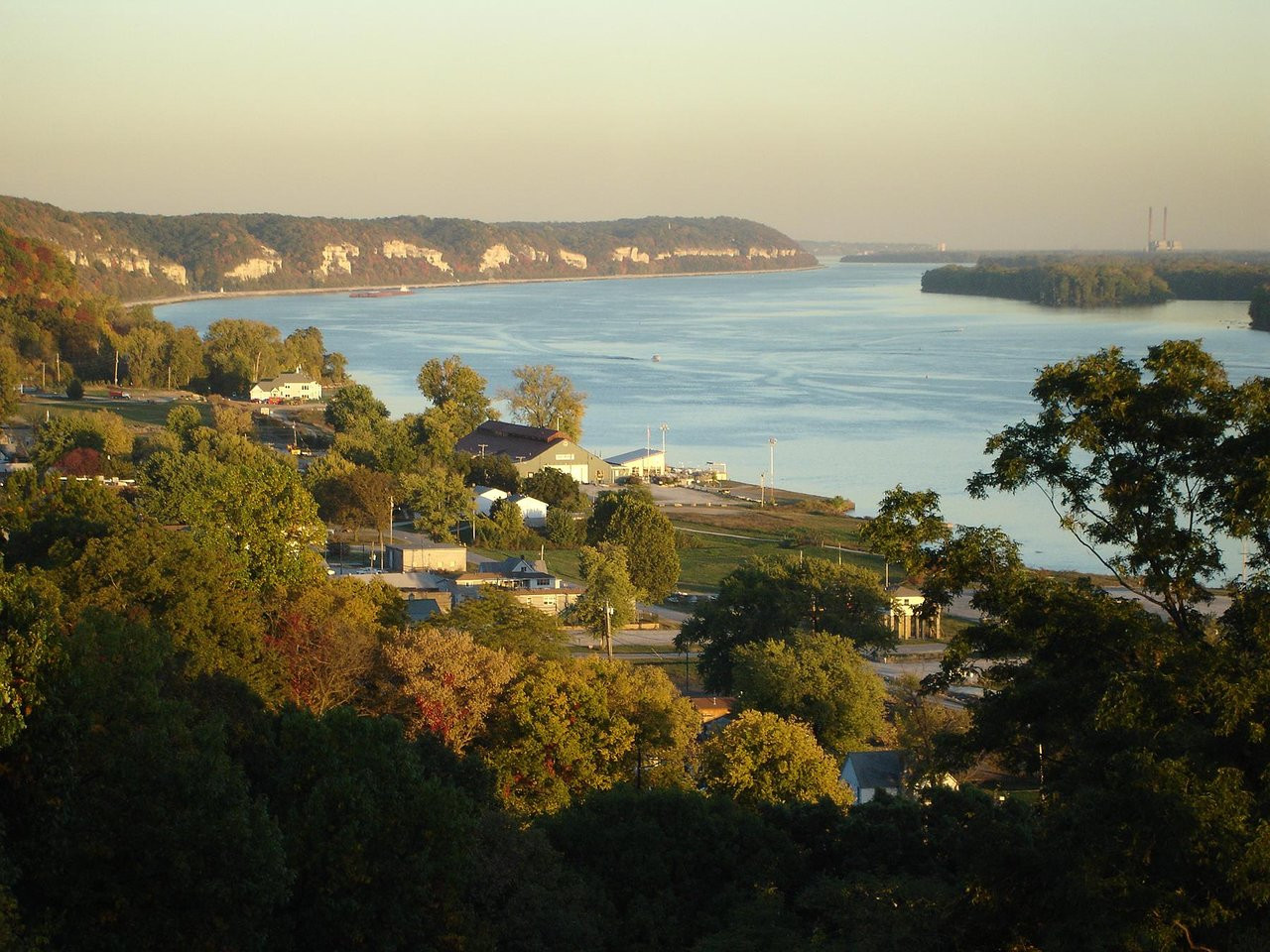
From a bustling commercial center to a community of just over 600 residents, Grafton’s history is a story of ambition, industry, floods and reinvention. Its ferry connection to St. Charles County remains one of the oldest threads in that story.
By Mike Batchelor | RiverNewsLive
GRAFTON, Ill. — On a summer afternoon, Grafton can feel like a place built for slowing down. Visitors stroll along the riverfront, boats move past the marina, and the limestone bluffs rise above a town whose permanent population is barely more than 600. It is easy to see Grafton as a picturesque little village at the meeting of two great rivers.
But the quiet streets tell only part of the story.
In the nineteenth century, Grafton was a significant center of river commerce, stone quarrying, boatbuilding and commercial fishing. Its founders imagined a major manufacturing and transportation hub, and for a time, the town appeared capable of becoming one of the important cities of the upper Mississippi Valley. The same rivers that brought Grafton prosperity would later help reshape its fortunes through changing transportation patterns and repeated devastating floods.
A City Born at the Meeting of Two Rivers
Grafton’s location was its original selling point. Situated near the confluence of the Illinois and Mississippi rivers, it occupied a natural crossroads for travelers and commerce moving between the Midwest and the Mississippi Valley.
James Mason, a Massachusetts businessman, settled the community in 1832. He envisioned a place where grist mills, woolen and cotton mills, manufacturing, trading and shipping could flourish. Mason received a license to operate a ferry across the rivers in 1833, but died the following year before much of his vision could be realized.
His widow, Sarah, and his brother, Paris, continued the work of surveying and platting the town in 1836. Sarah named it Grafton in honor of her husband’s birthplace in Massachusetts.
The town’s early ambitions were substantial. An 1837 description called Grafton a thriving settlement with about 500 inhabitants, stores, warehouses and a good steamboat landing. It predicted that the community would become an important thoroughfare for travelers crossing from Illinois into Missouri and continuing toward the Missouri River. Plans for a railroad connection and a large hotel reflected the confidence surrounding the young settlement.
Grafton suffered during the financial Panic of 1837, but its fortunes improved as river commerce expanded. By 1840, it had become the principal trading point in Jersey County. The completion of the Illinois and Michigan Canal in 1848 further increased the importance of the river system connecting Chicago, the Illinois River and the Mississippi.
When Grafton Helped Build St. Louis
The greatest engine of Grafton’s nineteenth-century prosperity was found in the bluffs behind the town.
The local stone was exceptionally well suited for construction. Commercial quarrying expanded in the late 1850s, and Grafton became a major supplier of building stone to
St. Louis and other river communities. Barges carried enormous blocks downstream, where they became part of the foundations and structures of a growing metropolitan region.
Grafton stone was used in prominent projects including the Eads Bridge and the Old Cathedral in St. Louis. At the height of the industry, five quarries employed approximately 2,000 men. The stone industry was so important that Grafton’s economy was tied not merely to its own growth, but to the construction of cities elsewhere.
The riverfront was busy with far more than stone. Boatbuilders produced barges, steam towboats, ferries, fishing boats and other vessels. Grist mills processed agricultural products, while commercial fishing became an important source of employment. Mussels harvested from the rivers later supplied material for the button industry, and an explosives manufacturing plant was established in 1907.
By 1867, Grafton supported a broad business community that included general stores, blacksmiths, mills, shoe shops, a butcher, a drug store, a watchmaker and silversmith, cooper shops and physicians. This was not simply a collection of homes along the river.
It was a working commercial town with the trades and services needed to support a substantial industrial population.
Some historical accounts place Grafton’s peak population at approximately 10,000 during the 1850s. That figure is widely repeated, although it should be treated as a historical estimate rather than a directly comparable modern census count. What is firmly documented is the scale of the town’s industry, including the thousands of workers employed in its quarries during the boom years.
The Ferry: Grafton’s Historic Connection to Missouri
The ferry crossing to Missouri is not a modern tourist invention. It reaches back to the very beginning of Grafton’s history.
In June 1833, the Greene County court granted Paris Mason permission to establish a ferry. Historical accounts describe the earliest crossing as a horse-powered boat, later replaced by a flatboat before horse-powered service returned when business improved. Ferries were essential to the movement of settlers, goods and travelers between Illinois and Missouri in an era when bridges were scarce and river crossings could determine the location of a community.
Judge William H. Allen established a steam ferry in 1856. That operation continued until 1862, when the Civil War disrupted intercourse between Illinois and Missouri and forced its abandonment. A historical county account stated that no regular ferry had operated afterward as of the time that account was written. It is important to distinguish that nineteenth-century service from the later automobile ferry, whose history includes several separate periods of operation.
The precise history of the modern crossing is not completely documented. A 2024 Illinois vehicle ferry assessment found recollections of regular ferry service in the late 1950s, but noted gaps in the record concerning operators, vessels and schedules. The assessment also documented a modern operation beginning in 2002, later acquired by the City of Grafton, with service interrupted at various times by flooding, siltation and other difficulties.
The city moved to acquire the Missouri landing in 2011, after previous private operations had struggled with closures and dredging problems. In 2013, service resumed under a contract with the Calhoun Ferry Company following an absence of nearly three years. The crossing remained an important transportation and tourism connection, although its operation continued to be affected by river conditions.
Today, the Grafton Ferry connects the Illinois riverfront near the lighthouse and Market Street with Grafton Ferry Road off Missouri Highway 94 in St. Charles County.
It provides a direct route between the two sides of the Mississippi that can save travelers approximately 30 minutes compared with the highway alternative.
The crossing entered a new chapter on April 10, 2026, when Grafton celebrated the launch of city-owned, year-round ferry service operated by the Calhoun Ferry Company. The expansion to seven-day-a-week service was intended to support commuters as well as visitors, strengthening the connection between Grafton and the growing St. Charles County corridor.
It is a remarkable continuity. Nearly two centuries after the Mason family recognized the importance of a crossing to Missouri, the ferry remains part of Grafton’s economic future.
Industry Fades, and the River Takes Its Toll
Grafton’s decline did not happen because of a single event. Its industries changed as the American economy changed.
The demand for traditional building stone fell as construction methods and materials evolved in the late nineteenth century. By the early twentieth century, Grafton stone was no longer widely used for major building construction. The quarries continued producing riprap and crushed stone on a smaller scale, but the great era of the building-stone industry had passed. Quarry operations continued until 1975.
Other river industries also diminished over time. Transportation patterns shifted, manufacturing changed, and the economic advantages that had once made Grafton such a promising commercial center were no longer enough to sustain its former scale.
Then there were the floods.
Grafton has always lived with the Mississippi and Illinois rivers, and flooding has repeatedly shaped the community. The flood of 1844 damaged early riverfront businesses, while later floods continued to threaten homes and commerce. The Great
Flood of 1993 became a defining moment, devastating much of the town and accelerating its transition away from its older industrial economy.
The population figures illustrate the transformation. Grafton had 918 residents in 1990, before the 1993 flood. By the 2020 Census, the population had fallen to 626. The city has since pursued development on higher ground, including the Grafton Hills subdivision, as part of efforts to retain and attract residents while reducing exposure to future flooding.
A Different Kind of River Town
Grafton did not disappear. It reinvented itself.
Where quarry workers and riverboat crews once dominated the local economy, tourism and recreation now play a central role. The town’s riverfront, marina, restaurants, shops, wineries and nearby outdoor attractions draw visitors from across the region. Pere Marquette State Park, the Great River Road and the surrounding bluffs have made Grafton a destination for people seeking the scenic beauty that earlier generations often viewed primarily as an economic resource.
The shift has brought new opportunities, but it has not erased the challenges of maintaining a small community in a flood-prone location. Grafton’s permanent population remains a fraction of the size suggested by its nineteenth-century ambitions, and its modern economy depends heavily on visitors and small businesses.
Yet the town’s history is still visible to anyone willing to look beyond the weekend crowds. The limestone buildings, old riverfront streets and working ferry are reminders that Grafton was once a place where fortunes were made from stone, boats and the movement of goods along the nation’s great waterways.
Today, the ferry carries commuters and tourists rather than the settlers and freight of the nineteenth century. The quarries are quiet, and the industrial bustle has given way to a different rhythm. But the reason Grafton exists remains unchanged: two rivers meet, and people still find a reason to gather at their shores.
Grafton may be small today, but its history is anything but.